
When adventurers Ed Jackson and Luke Tarrant set out for the remote peaks of Kyrgyzstan, they weren’t chasing records or glory. They were chasing something bigger: a chance to rewrite what it means to explore. Neither of them could have predicted what would happen next. They speak exclusively to Kate Stevenson
The idea had been brewing for years. Ed, a former rugby player who rebuilt his life after a spinal cord injury, had heard about untouched mountain ranges in Kyrgyzstan. These landscapes were supposedly so remote that no one had ever stood on some of their peaks.
“It wasn’t about ticking a box or going up high,” recalls Ed. “It was about going somewhere no human had ever been before, and putting a fl ag in the ground for adaptive adventure.”
When he met Luke, the plan began to take shape. Luke was adjusting to life as an amputee after losing his leg in a motorbike accident while travelling in South America. At the time, he was still physically recovering, emotionally processing, and trying to make sense of a life that had changed overnight. “I asked him to come out to Kyrgyzstan with me,” remembers Ed. “I could see from the noise, and think about what was next.” The pair also decided to use the First Ascent challenge to raise funds for Ed’s mental health charity, Millimetres to Mountains, and CDI’s Children at Risk programme for disabled kids in Kyrgyzstan.
Over the next few months, Luke threw himself into the challenge and the training. “I’ve always been an advocate for getting out there and living your life to the fullest,” he explains. “Now that I’m disabled, it hasn’t changed. It’s still my mantra. There are just extra considerations now.”
A NASTY SURPRISE
When the team reached Kyrgyzstan in late summer to start their ascent, anticipation was high, and their spirits were light. “We were laughing and joking, looking forward to the climb,” remembers Luke. “Then, within minutes, the whole thing was off .”
A painful swelling had appeared on Luke’s stump. On advice from his rehabilitation team back home, he visited a local clinic to have a small amount of fl uid drained in what should’ve been a simple, routine procedure. Shockingly, what followed was anything but routine.
“They assured me they understood and could carry out the procedure,” says Luke quietly. “In reality, this probably wasn’t true.”
“Things took a turn for the worse, and I ended up with a much bigger wound on my leg than I was expecting. It cancelled the climb for me completely.”
Within hours, his condition deteriorated: Luke now needed emergency surgery. What was meant to be a minor treatment had spiralled into something very traumatic for him. So much so, that Luke has since spoken out on social media about the medical vulnerability in a foreign hospital.
“The hardest part was that I wasn’t expecting it,” he sighs. “When I was in Colombia years ago recovering, every day was a grind, and I knew it would be hard. But in Kyrgyzstan, everything was fine, and then it wasn’t. It took me completely by surprise.”
ED’S ASCENT
Back at base camp, Ed was nervously waiting for updates on Luke’s condition. Eventually he was told Luke was being flown home. “I was shocked. Gutted for him, and gutted for myself,” he admits. “My first concern was his health. The mountains weren’t going anywhere after all.” But suddenly the climb now hung in the balance: should Ed continue alone, or return with Luke once he’d recovered?
After speaking with Luke, Ed decided to continue and finish the ascent – not just for himself, but for his friend, the charities, and for everyone whose mission it represented.
“I felt like I was carrying the torch for both of us,” he remembers. “Adventure is all about showing up and adapting when the plan falls apart, whether that’s on the side of a mountain or in life.”
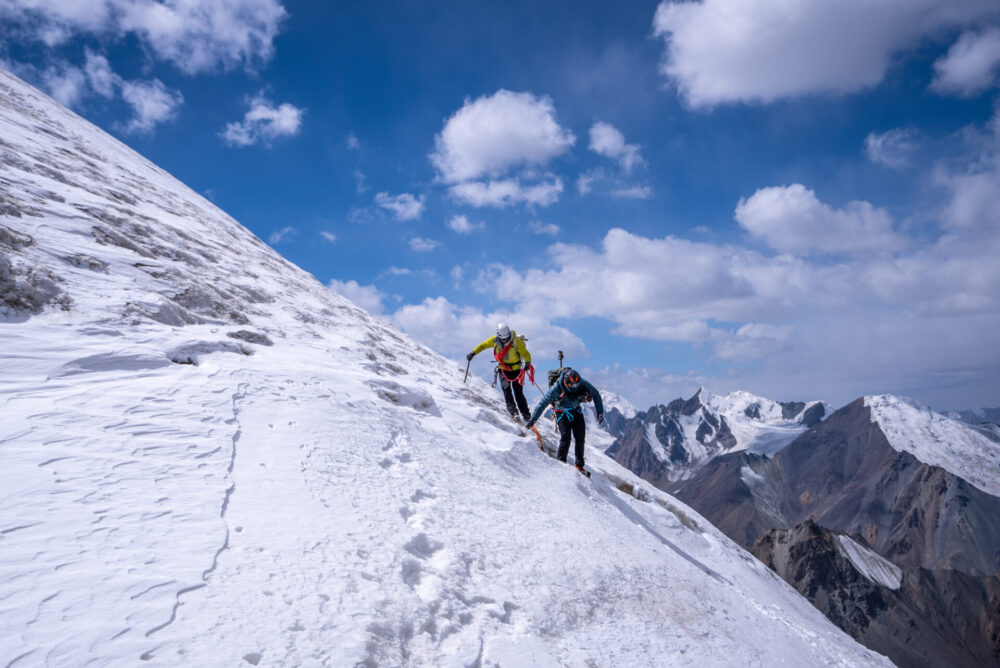
The climb that followed tested every ounce of Ed’s resilience. On steep ice, his adaptive technique – dragging one leg and balancing with modified crampons – was pushed to the limit.
“There was one point where my calves were screaming, and I thought, one mistake and that’s it,” recalls Ed. “Except I realised I didn’t need super strength, I just had to break the climb down into small steps. That’s how I learned to walk again, and that’s how we got to the summit.”
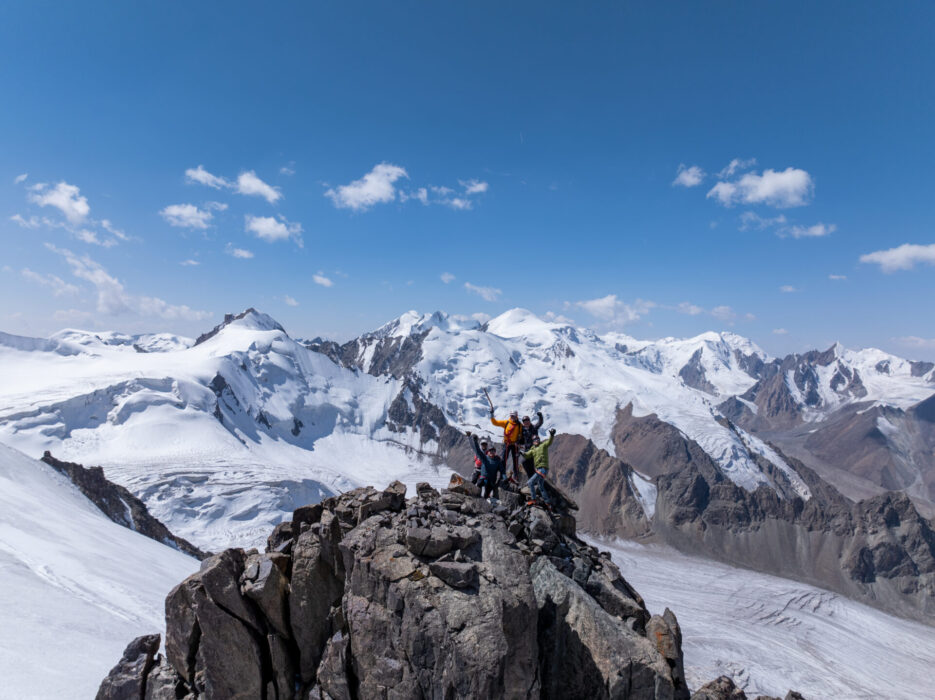
When Ed finally stood atop the unnamed 5000 metre peak, he fulfilled a promise to the local children from a Kyrgyz orphanage and named it in their honour. They chose Hope Peak, which – all things considered – was very fitting.
UNFINISHED BUSINESS
Now home, Luke is continuing to heal, both physically and emotionally. “I’m still heartbroken I couldn’t complete the challenge,” he admits. “But I’m happy Ed managed to, and that it’s been done for a great cause.”
“I’ve got unfinished business with mountains now though!” adds Luke. Despite everything, his spirit for adventure remains undimmed. “This hasn’t changed my mindset at all,” he says. “Being disabled just means doing things differently. My leg isn’t going to grow back. This is my life now, and I’ve made peace with that. Because, when I put my mind to something, there’s no stopping me.”
Both men are also already talking about what they should do together next. “Setbacks don’t mean it’s over,” Ed reminds me. “They just mean the story’s taking a different turn.”