
Dr Marie Tidball MP talks exclusively to Editor Melissa Holmes about her journey to
Parliament and MaternAble, her groundbreaking campaign to improve maternity
care for pregnant disabled people.
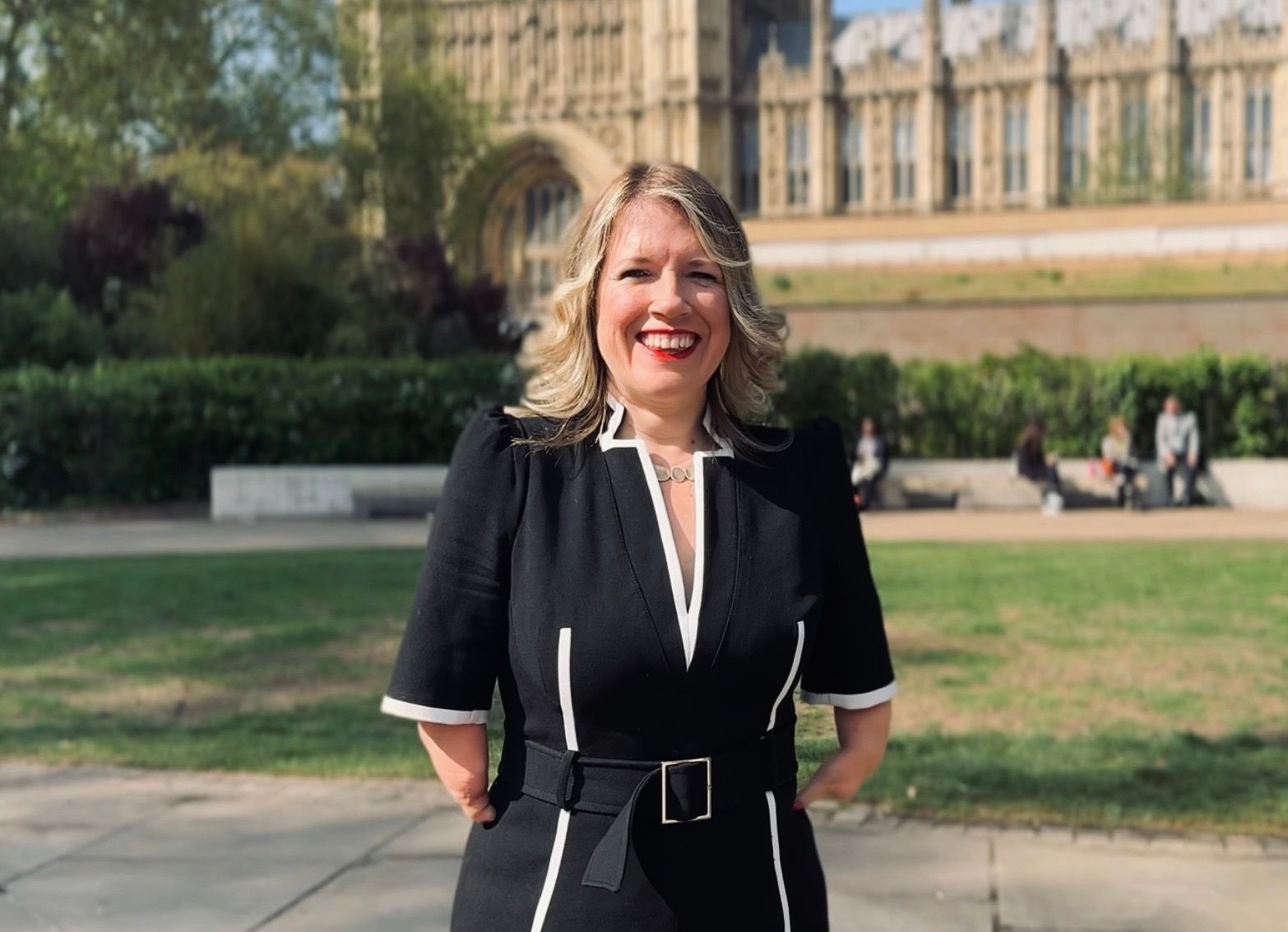
It was during her booking-in appointment with her midwife that Marie Tidball first realised how difficult the healthcare system can be for pregnant disabled women. The newly-qualified midwife repeatedly asked Marie to explain what her disability is. “I said: ‘I’ve got foreshortened arms and a digit on each hand’. She kept looking at me, then looking at my body and asking me to explain again – then I realised I was in the middle of a Two Ronnies sketch. She thought I was saying I had ‘four shortened arms’ and she was looking for the other two arms. That was the moment I realised it was going to be a bit problematic.”
Experiences like this are one of the reasons Marie – now Dr Marie Tidball, Member of Parliament for Penistone and Stocksbridge since 2024 – launched her MaternAble campaign. The nationwide initiative brings together pregnant disabled women, parents, researchers, Royal Colleges and health professionals. The campaign’s goal? To embed an inclusive maternity care pathway for disabled women into NICE guidelines, improve training, and transform support.
ALARM BELLS
Marie’s pregnancy was a worrying time. “No one seemed to know how my disability might interact with my pregnancy, which was surprising,” she says. Her excitement and joy was tempered by a referral for genetic counselling, focused on the idea that her baby would inherit her disability. “That was never even a consideration – we knew my disability wasn’t genetic in any case!” She found the experience “really upsetting,” saying it “set off alarm bells.”
Asking a registrar if she’d be able to have a vaginal birth, she recalls: “He asked me to lay on the bed, fully dressed, and asked if I could open my legs. That was his way of determining if I’d be able to have a natural birth, although I’d had a King’s Procedure in my hip and wear a prosthetic leg.”
Marie eventually needed a Caesarean because her baby’s heart rate dropped. Disabled women are 30% to 69% more likely to have a Caesarean birth, which can mean extra complications and longer recovery. The same research – by The London School of Hygiene & Tropical Medicine and the Missing Billion Initiative (MBI), which underpins the MaternAble campaign – shows disabled women are also 44% more likely to experience stillbirth or infant mortality than non-disabled women.
SAFE AND INCLUSIVE
Marie believes the goals of MaternAble will help women with a wide range of health conditions both before and after birth. “It would change attitudes towards disabled women having healthy sex lives, having babies, and being able to give birth in a safe and inclusive way where their pregnancy is celebrated,” explains Marie. She’s confident the findings of the campaign will also form part of the government’s rapid review into maternity care.
The need for post-birth support is essential too, with the MBI report finding breastfeeding levels are 35% to 70% lower among disabled mothers. MaternAble is working with REMAP to develop adaptive prams, cots and baby equipment, so disabled parents don’t need to spend time researching options during an already stressful time.
DO GOOD THINGS
Marie’s professional background is in law, with a special interest focusing on how disabled and neurodivergent people are treated in the criminal justice system. She’s also a founding director of the Oxford University Disability Law and Policy Project.
How would she describe her journey into politics? “Having a very visible physical disability – and as a woman – it’s tough,” she states. “I’m not going to deny it.” Feeling she must overcome assumptions and outperform non-disabled colleagues, she told me: “I’ve had to be very driven, which gives you the fire to get things done, but it’s hard.”
She wants to make her constituents proud, and is grateful to all those who worked with her to help her win her seat in Parliament, especially with physical tasks like knocking on doors and delivering leaflets: “That collectivism is what the Labour party’s about for me.”
IT’S EVERYONE’S PARLIAMENT
In Parliament, Marie has worked with disabled colleagues to set up the first disability parliamentary Labour group, and with whips, the Speaker and the modernisation committee to improve accessibility in the ancient buildings. “The more there is the sense that this space is for disabled people, the more it filters through to the expectation that we should have more disabled people represented in Parliament,” Marie states proudly. “This Parliament belongs to all of us. It’s not an elite – it’s everyone’s Parliament.”
She told me: “I always say to people who think they might want to get into politics: ‘Don’t be an MP because you want to be, become an MP to do good things’.”
Often asked whether she gets nervous before addressing the House of Commons, Marie admits: “I’m always extremely nervous in the days beforehand, but not when it happens. There are 40 million other disabled people sitting in wheelchairs or standing behind me – a lot of disabled people don’t have a chance to do this job. So I feel an enormous sense of duty to do as much as I can while I’m here – for my constituents, and for disabled people.”
